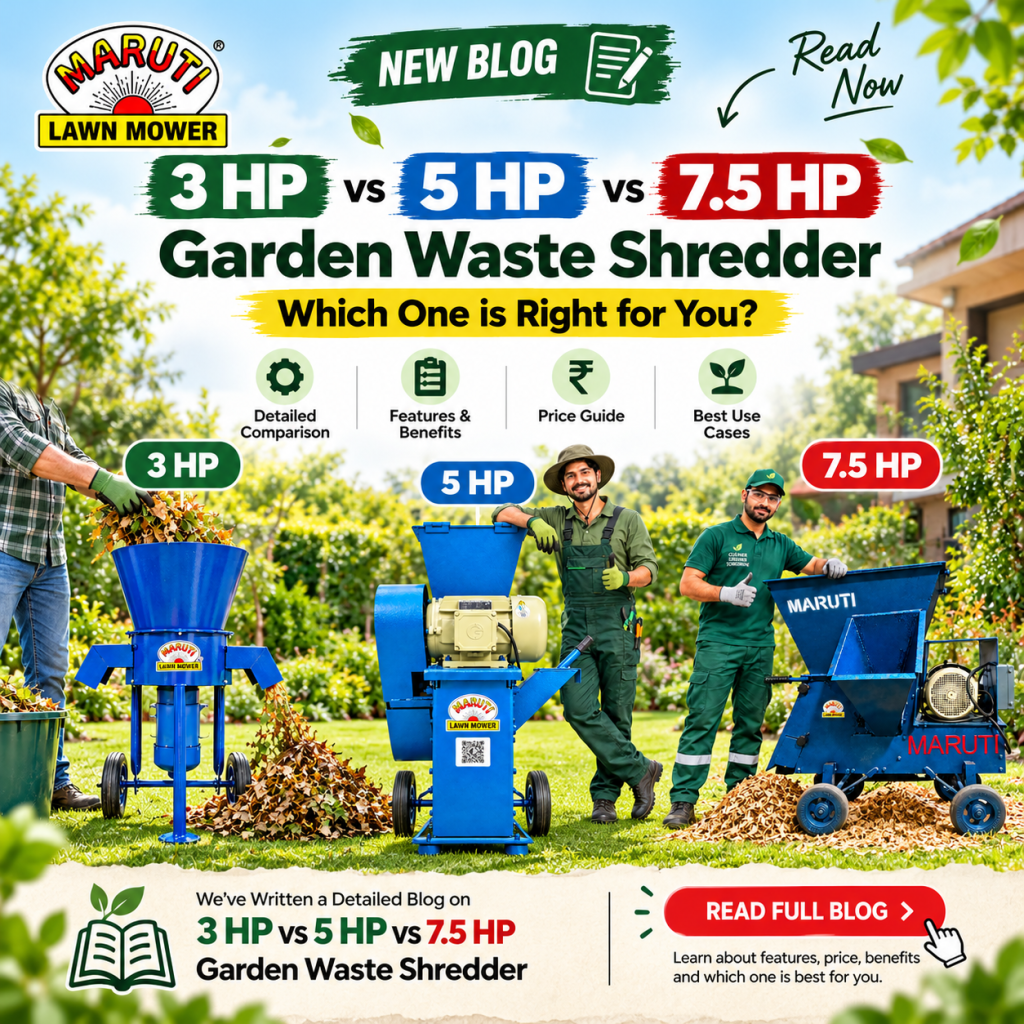
3 HP vs 5 HP vs 7.5 HP Garden Waste Shredder: Which One Should You Buy?
Managing garden waste efficiently is an important challenge for housing societies, parks, nurseries, landscaping companies, farms and commercial gardening facilities. Leaves, grass clippings, dry branches, pruning waste and other plant residues can accumulate quickly, creating disposal problems and increasing maintenance costs.
A garden waste shredder machine helps reduce suitable garden waste into smaller pieces, making it easier to handle, transport or process for composting, where appropriate.
However, choosing the right machine is not always straightforward. Buyers often compare 3 HP, 5 HP and 7.5 HP garden waste shredders because they want a machine that meets their waste-processing requirements without unnecessary operating expenses.
The main difference between these machines is their motor power. However, horsepower alone does not determine how much waste a machine can process. Cutting mechanism, blade design, material type, moisture content, branch diameter and machine construction also influence performance.
In this guide, we compare 3 HP, 5 HP and 7.5 HP garden waste shredders, explain their potential applications and help you decide which machine may suit your requirements.
1. What Is a Garden Waste Shredder Machine?
A garden waste shredder is a machine designed to cut or shred suitable plant material into smaller pieces. Depending on its design, it may process materials such as dry leaves, small branches, pruning waste and other specified garden residues.
These machines can help gardening teams manage waste more efficiently and prepare suitable organic material for further processing.
Common applications include:
Residential gardens and landscaped properties
Housing societies and residential complexes
Public parks and municipal gardens
Nurseries and landscaping businesses
Farms and horticultural facilities
Composting and organic waste management operations
A shredder can reduce the volume occupied by suitable waste, but the actual reduction depends on the material and the machine. Shredded material may be used in composting or mulching when appropriate, provided the material and processing method are suitable for the intended purpose.
Before purchasing, always check which materials the machine is designed to process. Not every garden waste shredder can handle thick branches, wet grass, fibrous plant residues or other difficult materials equally well.
2. What Does 3 HP, 5 HP and 7.5 HP Mean?
HP stands for horsepower, a unit used to express power. In a garden waste shredder, the motor’s power rating helps indicate its power capability, but it does not independently establish the machine’s processing capacity.
A 3 HP machine, a 5 HP machine and a 7.5 HP machine may differ in the amount of power available to drive their cutting mechanisms.
However, a higher horsepower rating does not automatically mean that a machine will process every type of garden waste faster.
Actual performance also depends on:
Blade number, geometry and sharpness
Cutting mechanism and rotor design
Motor speed and torque characteristics
Branch diameter and material hardness
Moisture content and material consistency
Feeding method and operator technique
Electrical supply and machine configuration
For example, a machine designed for thin branches may not be suitable for thick woody material, even if its motor power appears adequate.
The best approach is to compare complete machine specifications rather than making a decision based only on HP.
3. 3 HP vs 5 HP vs 7.5 HP Garden Waste Shredder: Comparison
The following table explains the general differences buyers should evaluate. These are application-based guidelines, not guaranteed capacity specifications for every machine.
| Comparison factor | 3 HP shredder | 5 HP shredder | 7.5 HP shredder |
|---|---|---|---|
| Motor power | 3 HP | 5 HP | 7.5 HP |
| Typical consideration | Lighter-duty requirements | Moderate-duty requirements | More demanding requirements, subject to design |
| Suitable waste | Within the machine’s rated limits | Within the machine’s rated limits | Within the machine’s rated limits |
| Workload suitability | Depends on daily waste volume | Depends on daily waste volume | Depends on daily waste volume |
| Purchase cost | Compare actual quotations | Compare actual quotations | Compare actual quotations |
| Operating expenses | Electricity, maintenance and labour | Electricity, maintenance and labour | Electricity, maintenance and labour |
| Space requirements | Check the actual dimensions | Check the actual dimensions | Check the actual dimensions |
| Best buying approach | Match to the required workload | Match to the required workload | Match to the required workload |
A 3 HP machine may be sufficient for a smaller operation, while a 5 HP or 7.5 HP model may be worth considering for a higher workload. The correct choice depends on the machine’s verified specifications and the type of waste being processed.
4. 3 HP Garden Waste Shredder: Is It the Right Choice?
A 3 HP garden waste shredder may be suitable for buyers who need to manage a relatively modest quantity of compatible garden waste.
For example, a smaller gardening operation may collect leaves, light pruning residues and small branches periodically rather than processing large quantities every day.
Potential applications
A 3 HP model may be worth evaluating for:
Smaller gardens and landscaped properties
Nurseries with modest waste volumes
Light-duty garden maintenance
Small-scale organic waste management
Operations where waste can be processed in planned batches
The machine must still be suitable for the actual material being fed into it. Confirm the maximum recommended branch diameter and the types of plant material it can handle.
Advantages to consider
A smaller-power machine may have a lower purchase cost than a larger model in a comparable product range. It may also suit operations where a larger machine would be unnecessary.
However, purchase price and running cost should be verified from the actual product specifications and quotation.
Limitations to consider
If the amount of waste is substantial or the material is difficult to process, a 3 HP machine may not meet the required productivity.
The machine may require more operating time or additional labour to handle the same workload, depending on its cutting design and processing performance.
Who should consider a 3 HP garden waste shredder?
Buyers managing smaller quantities of suitable garden waste should evaluate this option first, provided the machine’s rated capacity matches their requirements.
5. 5 HP Garden Waste Shredder: A Middle-Ground Option
A 5 HP garden waste shredder can be a useful option for buyers who need to evaluate a machine between lighter-duty and higher-power configurations.
It may be appropriate for operations that generate regular garden waste but do not necessarily require the specifications of a more powerful machine.
Potential applications
Depending on the machine design, a 5 HP model may be worth considering for:
Medium-sized landscaped properties
Regular garden maintenance operations
Nurseries and horticultural facilities
Housing societies with manageable garden waste volumes
Small landscaping businesses
Organic waste preparation for suitable composting processes
The actual suitability depends on the machine’s construction, rated capacity, feeding arrangement and the nature of the waste.
Advantages to consider
A 5 HP machine may offer a useful balance between power requirements and the workload of a particular operation.
For buyers who find a smaller machine insufficient, this category may provide an alternative without automatically moving to a higher-power model.
Limitations to consider
A 5 HP machine may still be unsuitable for very demanding applications, especially when processing thick branches or large quantities of inconsistent material.
Do not assume that a machine can process a specific amount of waste per hour without verified manufacturer data or a suitable demonstration.
Who should consider a 5 HP garden waste shredder?
Evaluate this option if your operation produces garden waste regularly and a smaller machine may not provide the required performance. Confirm the machine’s rated capacity before purchasing.
6. 7.5 HP Garden Waste Shredder: When Should You Consider It?
A 7.5 HP garden waste shredder offers a higher motor power rating than the 3 HP and 5 HP alternatives. It may be worth considering when a buyer expects a more demanding workload and the selected machine is specifically designed for that application.
Higher motor power can be beneficial, but the machine’s cutting system and material-handling specifications remain essential.
Potential applications
Depending on its rated specifications, a 7.5 HP model may be evaluated for:
Larger landscaped properties
Regular garden waste management
Landscaping and horticultural operations
Housing societies with substantial garden maintenance requirements
Operations that process suitable plant residues frequently
These are potential use cases, not a guarantee that every 7.5 HP model is suitable for each application.
Advantages to consider
A higher-power model may provide greater power capability for compatible workloads.
For a business processing garden waste regularly, this may be worth evaluating against the productivity requirements, available electrical supply, operator needs and overall ownership cost.
Limitations to consider
A higher-power machine may have a higher purchase price and different electrical requirements. It may also need more space or different maintenance arrangements, depending on its construction.
Before buying, verify the motor configuration, power supply requirements, dimensions, weight, blade specifications and recommended material limits.
Who should consider a 7.5 HP garden waste shredder?
Buyers with a more demanding workload should evaluate a 7.5 HP model alongside its actual processing specifications. Do not choose it simply because it has the highest horsepower rating in this comparison.
7. Which Garden Waste Shredder Is Best for Housing Societies?
Housing societies often generate garden waste from lawns, hedges, landscaped areas, trees and routine pruning.
The best shredder depends on the amount of waste collected, the type of material, the frequency of maintenance and the space available for operating the machine.
A smaller society with limited landscaping may find a lower-power model sufficient. A larger property with frequent pruning and substantial garden waste may need to compare higher-power options.
Before purchasing, the maintenance team or RWA should assess:
The approximate amount of garden waste generated each day or week.
The types of leaves, branches and other plant material collected.
The maximum branch diameter that needs to be processed.
The electrical supply available at the operating location.
The labour and time required to collect and feed the waste.
The location where the shredded material will be stored or processed.
If composting is the objective, the society should also establish a suitable process for managing the shredded material.
A site assessment and product demonstration can help confirm whether the selected machine is appropriate.
8. How to Choose a Garden Waste Shredder Based on Daily Waste Volume
Daily waste volume is often more useful than horsepower alone when selecting a machine.
Begin by estimating how much waste your property generates during normal maintenance and during periods of heavy pruning.
Next, identify the material that makes up most of the waste.
Dry leaves and thin branches may behave differently from fresh green material, thick woody branches or fibrous residues. These differences influence the machine’s performance.
Ask the supplier for verified information about:
Rated processing capacity under specified conditions
Maximum recommended branch diameter
Compatible waste materials
Motor specifications and power consumption
Recommended operating schedule
Maintenance requirements
Safety features and operator instructions
Where possible, arrange a demonstration using material similar to the waste your operation generates.
This is particularly important for commercial buyers because an unsuitable machine can create delays, increase labour requirements and affect operating costs.
9. Electricity Consumption and Operating Costs
The total cost of a garden waste shredder includes more than its purchase price.
For electrically powered models, consider the following expenses:
Electricity consumption
Routine machine maintenance
Blade sharpening or replacement
Operator labour
Spare parts
Repairs and downtime
A higher horsepower rating does not by itself determine the machine’s exact electricity consumption. Actual energy use depends on motor efficiency, operating load, operating duration and machine configuration.
For a rough theoretical illustration, 1 HP is approximately 0.746 kW of mechanical power. Therefore, the nominal mechanical power equivalents are approximately 2.24 kW for 3 HP, 3.73 kW for 5 HP and 5.60 kW for 7.5 HP.
These are mechanical power equivalents, not guaranteed electrical input ratings or measured consumption. Actual electrical demand can be higher because of motor losses and can vary during operation.
Ask the manufacturer for the rated electrical input and recommended supply requirements before estimating electricity expenses or arranging installation.
10. Common Mistakes to Avoid When Buying a Shredder
Choosing only by horsepower
A higher HP rating does not automatically guarantee better performance for every material. Compare the complete specifications.
Ignoring the type of waste
A machine designed for leaves and small branches may not be suitable for thick woody branches or other difficult materials.
Overlooking electrical requirements
Check whether the motor requires a single-phase or three-phase supply, along with the appropriate voltage and electrical protection.
Assuming a processing capacity
Avoid relying on unsupported claims about kilograms or cubic metres per hour. Request verified figures and understand the conditions under which they were measured.
Ignoring maintenance
Blades, bearings, motors and other components require appropriate inspection and maintenance. Confirm service availability and spare-part arrangements.
Buying without checking safety features
Review guards, emergency controls where applicable, feeding arrangements and the manufacturer’s safety instructions. Operators should receive appropriate training and use the required protective equipment.
11. Why Consider Indian Rubber Industries?
Indian Rubber Industries manufactures and supplies lawn and garden maintenance machinery, including garden waste shredders for different applications.
When evaluating a garden waste shredder from Indian Rubber Industries, compare the available models according to their verified specifications and your operational requirements.
Consider the following before making an enquiry:
Motor horsepower and phase configuration
Blade design and number of blades
Recommended material types
Maximum supported branch diameter
Rated processing capacity
Machine dimensions and weight
Electrical requirements
Warranty, servicing and spare-part availability
These details help you identify whether a 3 HP, 5 HP or 7.5 HP model is appropriate for your workload.
Explore the garden waste shredder machine range at Indian Rubber Industries to review available products and contact the company for current specifications and pricing.
12. Frequently Asked Questions
1. What is the difference between a 3 HP, 5 HP and 7.5 HP garden waste shredder?
The main difference is the motor’s rated power. However, cutting performance also depends on the blade design, cutting mechanism, material type and rated capacity. Compare the complete specifications before choosing a model.
2. Which garden waste shredder is suitable for a small garden?
A 3 HP model may be worth evaluating for smaller workloads if its rated capacity and material limits match the garden’s requirements. Confirm the recommended branch diameter and compatible waste types with the supplier.
3. Is a 5 HP garden waste shredder suitable for a housing society?
It may be suitable for a housing society with a manageable volume of compatible garden waste. The correct choice depends on the property’s size, waste volume, material type and frequency of operation.
4. When should I choose a 7.5 HP garden waste shredder?
Consider a 7.5 HP model when your workload may require greater motor power and the machine’s specifications support your intended materials. Confirm the processing capacity, electrical supply and operating requirements before purchasing.
5. Does a higher HP shredder process more waste per hour?
Not necessarily. Higher power can be useful, but processing capacity depends on several factors, including the cutting mechanism, material type and machine design. Use verified capacity data to compare models.
6. Can garden waste shredders help with composting?
Shredding suitable garden waste can make it easier to handle and may help prepare material for composting. Successful composting also depends on the material mix, moisture, aeration and the overall composting process.
7. What should I check before buying a garden waste shredder?
Check motor power, electrical configuration, compatible materials, maximum branch diameter, rated capacity, machine dimensions, maintenance requirements, warranty and spare-part availability.
8. What is the price of a 3 HP, 5 HP or 7.5 HP garden waste shredder?
Prices depend on the model, construction, motor configuration, cutting mechanism and included features. Request a current quotation from the manufacturer for each model and compare specifications alongside the price.
9. Is a 7.5 HP shredder always better than a 3 HP model?
No. A higher-power model may be unnecessary for a small workload. The best machine is the one that meets your processing requirements safely and economically.
10. Where can I buy a garden waste shredder machine in India?
You can contact manufacturers and machinery suppliers directly. Indian Rubber Industries offers garden waste shredding machinery; enquire about available models, specifications, pricing and suitability for your application.
Conclusion
Choosing between a 3 HP, 5 HP and 7.5 HP garden waste shredder requires more than comparing horsepower ratings.
A 3 HP model may suit a smaller workload, a 5 HP model may be worth evaluating for regular garden maintenance, and a 7.5 HP model may be appropriate for more demanding applications when its specifications support the intended use.
The right choice depends on daily waste volume, material type, branch diameter, processing requirements, electrical supply and maintenance costs.
Before purchasing, compare verified machine specifications and request a demonstration when possible.
Looking for the right garden waste shredder for your garden, housing society, nursery or commercial operation? Contact Indian Rubber Industries to discuss your requirements and request current product specifications and pricing.
