
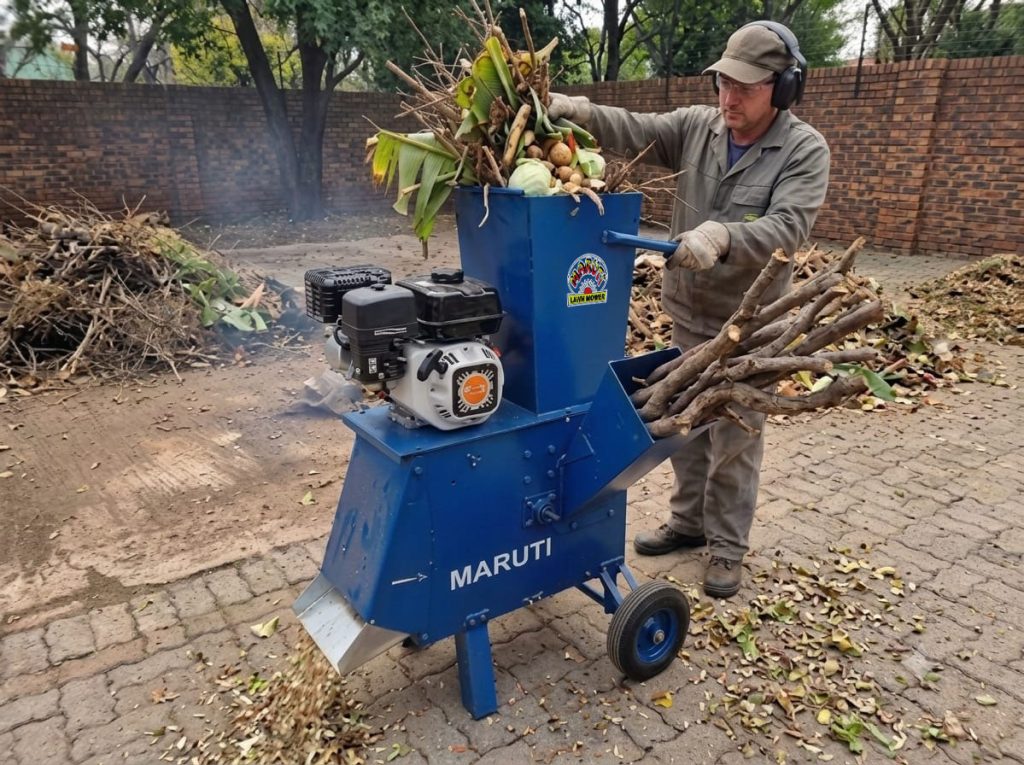
For Resident Welfare Associations (RWAs), gated townships, and large facility campuses across India, green waste disposal has evolved from a routine landscaping task into a major recurring monthly expense. Municipal corporations and private waste contractors charge steep per-trolley tipping and hauling fees to collect raw branches, hedge pruning, and seasonal leaf drop. Transitioning to on-site processing with a heavy-duty garden waste shredder machine delivers dramatic financial savings, operational control, and environmental compliance. Lets find out the difference between Maruti garden waste shredder machine cost savings vs municipal pickup fees.
How Much Can an RWA Save by Shredding Garden Waste On-Site Instead of Municipal Pickup?
On-site shredding delivers a dual financial benefit: it completely eliminates monthly waste hauling contractor fees while creating high-value organic compost for society gardens. Raw, un-shredded garden waste is bulky and light, requiring multiple tractor-trolleys every month during heavy pruning seasons. By shredding foliage, branches, and trimmings on-site, volume is reduced by up to 80-90%. RWAs achieve rapid financial payback by replacing recurring municipal tipping charges with a one-time capital equipment investment. Discover how gated communities optimize layouts in our guide on garden waste shredders for housing societies.
Why Are Municipal Green Waste Tipping and Hauling Costs Rising for Housing Societies in India?
Municipalities across Indian metro cities are increasingly enforcing strict waste segregation policies and levying higher tipping fees on bulk waste generators. Under Solid Waste Management (SWM) Rules 2016, residential complexes generating significant organic waste are mandated to process wet and green waste within their own premises. Municipal bodies are penalizing societies that dump unsegregated garden trimmings into municipal bins or hire illegal private tractor operators, making on-site shredding the only legally compliant and financially sustainable solution.
How Does an On-Site Garden Waste Shredder Help Bulk Waste Generators Comply with SWM Rules 2016?
Solid Waste Management Rules 2016 define large residential complexes as “Bulk Waste Generators,” requiring them to segregate waste at source and process organic bio-degradable matter on-premises. A Maruti garden waste shredder accelerates in-situ composting by converting bulky leaves, twigs, and kitchen scraps into uniform, high-surface-area particles. This rapid decomposition prevents foul odors, eliminates pest breeding in raw waste piles, and fulfills municipal eco-compliance audits without relying on external waste collection infrastructure.
Can Shredded Garden Waste Replace Commercial Topsoil & Fertilizer Purchases for Society Gardens?
Yes. Housing societies frequently spend tens of thousands of rupees annually purchasing commercial topsoil, chemical fertilizers, and cow dung manure for lawn and garden maintenance. On-site shredding converts green trimmings into nutrient-dense, carbon-rich mulch and compost. Applying this shredded mulch directly to garden beds conserves soil moisture, prevents weed proliferation, and enriches soil microbiology-completely eliminating external fertilizer and topsoil procurement expenses. For heavy pruning management, explore our dedicated wood chipper machine guide.
Should RWAs Choose an Electric or Petrol Garden Waste Shredder for Maximum Savings?
Evaluating power source options ensures the lowest operating cost per ton of shredded waste:
| Machine Power & Type | Operating Cost Structure | Throughput & Capacity | Best Financial Match |
|---|---|---|---|
| 3 HP – 5 HP Electric | Lowest running cost (grid electricity); minimal maintenance | 150–300 kg/hr; leaves, grass, daily hedge trimmings | Small-to-medium RWAs with centralized composting pits |
| 5 HP – 7.5 HP Electric / Petrol | Balanced fuel/power cost; handles thicker branches up to 2″ | 300–600 kg/hr; mixed garden prunings & foliage | Medium-to-large housing societies & institutions |
| 10 HP – 15 HP Petrol / Diesel | High mobile throughput; zero reliance on society power grid | 800–1500+ kg/hr; heavy logs, palm fronds, storm debris | Large residential townships, commercial parks, farmhouses |
For rainy season operation, read our technical breakdown on shredding wet leaves during Indian monsoons, and keep your equipment running reliably with our petrol garden shredder maintenance tips.
Frequently Asked Questions (FAQs)
1. How quickly can an RWA recover the investment cost of a garden waste shredder?
Most housing societies achieve full payback in 6 to 12 months by completely eliminating private tractor hauling fees, municipal tipping charges, and garden manure purchase expenses.
2. Does on-site shredding create noise pollution in residential societies?
No. Maruti electric garden waste shredders operate with low noise output suitable for residential hours. Petrol models feature vibration-dampened engine mounts and enclosed cutter housings for quiet operation.
3. Why choose a Made in India Maruti shredder over cheaper imported models?
Imported light-duty shredders frequently breakdown on fibrous Indian foliage, and replacement blades are rarely available. Maruti machines are built in New Delhi with heavy steel frames and locally available spare parts, ensuring long-term operational uptime.
4. How much space is needed to operate a garden waste shredder in a society?
A compact 3 HP or 5 HP Maruti shredder requires only a 6×6 foot hard surface area near society compost pits or garden storage sheds.
5. Can the RWA sell excess compost generated from shredded garden waste?
Yes! Many forward-thinking RWAs package excess organic compost generated from shredded garden waste and sell it to residents or local nurseries, creating an additional revenue stream for society funds.
Author & Credibility Note: Published by the engineering team at Maruti Lawn Mowers Udyog (Indian Rubber Industries Pvt Ltd, New Delhi) – pioneer manufacturers of horticulture and organic waste management machinery in India for over 40 years. Learn more about our manufacturing standards on our Why Buy a Maruti page. Follow us on Facebook for product offerings and updates.
Calculate Your Society’s Waste Savings Today
Want a customized cost-savings estimate for your RWA or commercial campus?
Call or WhatsApp us directly: +91-9560357800
